• Dine Out For A Cause With Pilot Light Picks!

    Dine Out For A Cause With Pilot Light Picks!

    Dine out for a cause this June to support food literacy for students nationwide! 

    Pilot Light Picks is a new city-wide fundraiser where restaurants across Chicago are designating a special menu item to benefit Pilot Light’s mission of advancing Food Education across the country. Check out our list of participating restaurants and menu items below and plan your trip to visit them in support of food literacy all month long!

    Pilot Light Picks Restaurants & Menu Items 

    Lilac Tiger

    • 15% of all Vada Pav potato croquette sliders sold 

    Kimski

    • $1 per Polish sausage sold 

    Dimmi Dimmi Corner Italian

    • $1 from each Caesar salad sold 

    The Table at Crate

    • $1 from each Waffle Fries & Aioli sold 

    The Bowline

    • A portion of all Bowline Burger sales sold 

    Rockwell Bottle Shop & Coffee

    • Choose to round up your change to support Food Literacy all month long 

    Rockwell’s Neighborhood Grill 

    • $1 per burger of the week sold 

    El Che Steakhouse and Bar

    • $1 of each Empanada sold

    Brasero 

    • $1 of each Pao de Quiejo sold

    Visit a local favorite or discover your next food obsession with Pilot Light Picks! Thank you to all the restaurants and diners who are supporting our mission this summer. Interested in adding your restaurant to this list? Click here to fill out our registration form and we’ll be in touch soon! 

    A young child wearing a chef's hat and apron smiling at the camera with the Pilot Light Picks: Feeding the Future of Food Education logo inscribed on the image.

  • Food-Based Science Learning: Teaching NGSS-Aligned Science Through Food and Community

    Food-Based Science Learning: Teaching NGSS-Aligned Science Through Food and Community

    Food-based science learning is one of the most powerful ways to make science meaningful, culturally relevant, and highly engaging for students. In my classroom, food isn’t seen as an add-on or a one-off; we treat food as a constant vehicle to drive learning as a phenomenon, a system, and a tool for sensemaking. By emphasizing food in the classroom, students engage in authentic scientific practices while connecting their learning to their lives, families, and communities. It’s also fun, delicious, and highly relatable to every student in the classroom as everybody eats!

    Meet the Author

    I am a middle school science teacher in Chicago, where I teach in a K-8 school. Over the past several years I have worked to integrate food into my teaching practices, aligning Pilot Light’s Food Education Standards with the NGSS. Through partnerships and place-based investigations, I’ve found that food-based science learning creates access points for students to engage deeply in science. I’m including A LOT of standards to show how versatile and flexible teaching with food can be!

    Using Food as a Phenomenon to Drive Inquiry

    One of the most effective ways to integrate food into science instruction is by using it as an anchoring phenomenon for instruction. Instead of bringing the food in at the end (although we do that too), I introduce concepts through a food-lens, giving all students the same strong and highly engaging foundation for instruction. 

    • Do strawberries have DNA?

      • Activity: “Observation Station” – Students observe, sketch, handle, and (if ok) eat strawberries
      • Standards that could be introduced with this activity: MS-LS1-1, MS-LS1-2, MS-LS1-3, MS-LS1-4, MS-LS3-1, MS-LS3-2, MS-LS3-3, MS-PS1-1, MS-PS1-2, MS-PS1-4, MS-ETS1-1, MS-ETS1-2
    • Why do some foods spoil faster than others?

      • Activity: “Ew or Mmmm?” – Student observe (see, smell, touch, NO taste) a selection of unripe, ripe, and rotten fruits
      • Standards that could be introduced with this activity: MS-LS1-5, MS-LS1-6, MS-LS1-7, MS-LS2-1, MS-LS2-3, MS-LS2-4, MS-LS2-5, MS-LS4-4, MS-PS1-2, MS-PS1-4, MS-PS3-3, MS-PS3-4, MS-ESS2-1, MS-ESS3-3, MS-ETS1-2, MS-ETS1-3
    • How can we grow food in small spaces?

      • Activity: “Case Study” – Students can do case study analysis of urban farms in Chicago
      • Standards that could be introduced with this activity: MS-LS1-5, MS-LS1-6, MS-LS2-1, MS-LS2-3, MS-LS2-4, MS-LS2-5, MS-LS4-5, MS-PS3-3, MS-PS3-4, MS-ESS3-1, MS-ESS3-3, MS-ESS3-4, MS-ETS1-1, MS-ETS1-2, MS-ETS1-3

    Connecting Food to Systems Thinking

    Food also allows students to explore systems, which is central to NGSS. In our classroom, students investigate:

    • Food webs using local ecosystems like Lake Michigan

      • Activity: “Build a Living Food Web” – Students are assigned organisms from a Lake Michigan ecosystem and use string to connect feeding relationships, then simulate a disruption (invasive species or pollution) and observe impacts. 
      • Standards that could be taught: MS-LS2-1, MS-LS2-2, MS-LS2-3, MS-LS2-4, MS-LS2-5, MS-LS4-4, MS-LS4-5, MS-ESS3-3, MS-ESS3-4, MS-ETS1-2, MS-ETS1-3
    • Supply chain systems (how food gets to our school trays)

      • Activity: “Trace Your Lunch” – Students pick a lunch item and map its journey from production to plate. Groups identify inputs, outputs, delays, and risks, then propose improvements.
      • Standards that could be taught: MS-LS2-3, MS-LS2-4, MS-PS1-2, MS-PS3-3, MS-PS3-4, MS-ESS3-1, MS-ESS3-3, MS-ESS3-4, MS-ETS1-1, MS-ETS1-2, MS-ETS1-3
    • Human body systems (digestion and nutrient absorption)

      • Activity: “Model the Digestive System” – Students simulate digestion using simple materials (crackers/bread & water & zip bag & “stomach acid” like vinegar). They model mechanical and chemical digestion and track how nutrients would be absorbed
      • Standards that could be taught: MS-LS1-2, MS-LS1-3, MS-LS1-7, MS-PS1-2, MS-PS1-4, MS-PS3-4, MS-ETS1-2

    Integrating Community and Place-Based Learning

    Food connects directly to students’ communities, making it an ideal entry point for place-based education. Through garden, school, and community-based work, students engage in science that is visible, relevant, and actionable. Students:

    • Grow and analyze plant life cycles

      • Activity: “Plant, Track, Explain” – Students plant seeds , track growth over time, and analyze patterns in growth stages using data and models.
      • Standards that could be taught: MS-LS1-5, MS-LS1-6, MS-LS2-1, MS-LS2-3, MS-LS2-4, MS-ETS1-3
    • Investigate environmental factors affecting plant growth

      • Activity: “What Do Plants Need?” Investigation -Students test variables (light, water, soil, nutrients, space) and compare plant growth outcomes across conditions.
      • Standards that could be taught: MS-LS1-5, MS-LS1-6, MS-LS2-1, MS-LS2-3, MS-PS3-3, MS-PS3-4, MS-ETS1-3
    • Connect food systems to issues like sustainability and access

      • Activity: “Community Food System Audit” – Students map local food sources (stores, gardens, markets), identify patterns in access, and propose solutions.
      • Standards that could be taught:  MS-LS1-5, MS-LS1-6, MS-LS2-1, MS-LS2-3, MS-PS3-3, MS-PS3-4, MS-ETS1-3

    Closing Thoughts

    These experiences extend beyond the classroom. Students begin to see themselves as contributors to their community and as participants in larger environmental systems. Food-based science is about making the class more rigorous, more accessible, and more connected by providing some footing for each and every student to access the curriculum. By using food as a phenomenon, a system, and a bridge to community, educators can create classrooms where all students can engage in authentic scientific practices. 

    Get Started

    Ready to use food in your classroom next school year? Applications to join the next Food Education Fellowship are now open! Learn more. 

  • A Food Activity for Math Classrooms

    A Food Activity for Math Classrooms

    A Food Activity for Math Classrooms is a great way to introduce food instructions. It is also a wonderful pathway to creating delicious weekly lessons. This activity is applicable for all grade levels, from preschool to high school.

    Want a food experience activity for your measurement math lesson? Super! You’ve come to the right place. It doesn’t matter the grade level you teach or the learning level of your students. A Food Activity for Math Classrooms keeps it fun and simple, with easy, quick clean-up. 

    Hi, I am Cynthia Brawner, a 25+ year veteran teacher in Chicago Public Schools at Wadsworth STEM Elementary, where Dr. Rashid Shabazz is my principal. I am also a Pilot Light Food Education Fellowship Alum (23-24). I enjoy non-traditional teaching, that is, teaching a standards-based, content area lesson with food and lessons that include introductory tech mini-projects. By day, I am an ELA, a Social Studies, and a Writing teacher to about 55 third-graders.

    How it Started

    Some years ago, while teaching math (Yes, for 98% of my career, I taught all subjects when my class was self-contained, and there were 25 to 27 students in my classroom), I needed something innovative and exciting because I was getting bored with teaching the same curriculum. The curriculum is great, and I do enjoy its content. However, I needed it to be a bit more exciting, given its focus on measurement.  

    Measurement is often one of those math subjects students frequently struggle with. Each year, I added something new, upgraded the primary calculators (1:1 ratio) bought fancy pencils, more stickers, digital scales (one per group), cubes, timers, and more. 

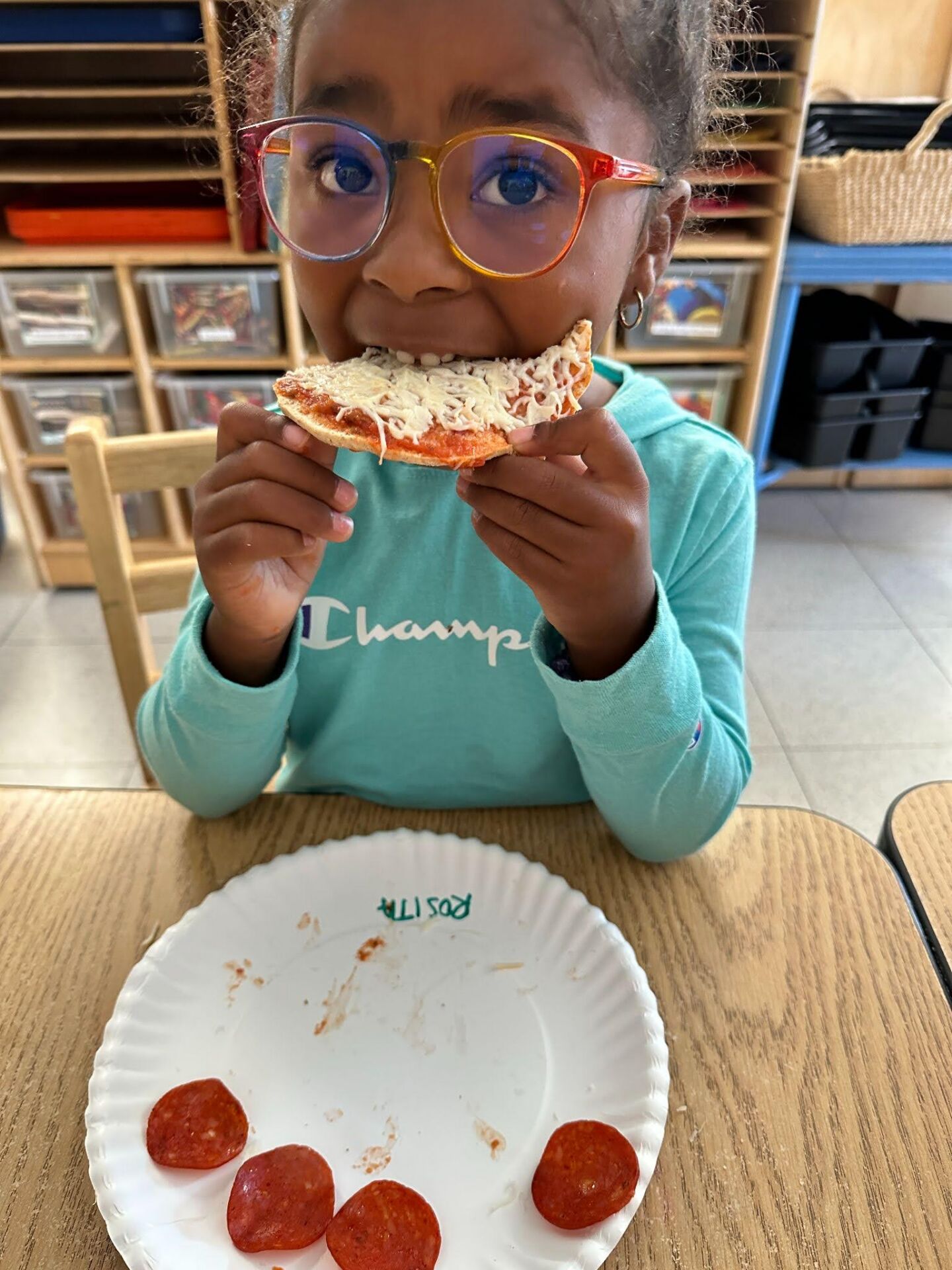
    So, one year, I decided to up my “teaching game.” Students love to eat, so I polled my students on their favorite foods. Guess which won the #1 spot? Pizza!  Yes, pizza. “Oh my gosh,” I thought. Lo and behold, I had an “Ah, Ha!” moment and I made a decision. An awesome decision, I thought. I went to my principal – “Yes,” he said. I went to our lunchroom manager – “Yes, after all lunch periods,” she said. I dubbed it “Operation Math Food.”  Operation Math Food was in full force. A quick, easy, and informed snack choice was on its way!

    The Setup

    My favorite shop ‘til you drop for the classroom was a store where all items were a dollar. I bought measuring spoon sets, mini storage bin sets, measuring cups, storage zipper bags, sandwich zipper bags, Olive Oil, and popcorn flavored seasoning (I’ll explain later). I purchased online a 19- to 20-quart storage bin with a locking lid for all the dry goods, oil, tasting spoons, #2 pencils, and parchment paper.

    The Content Area: Math Measurement

    In this lesson, we move beyond the worksheet. After introducing measurement, I used a step-by-step process to provide an interactive, real-life measurement activity through A Food Activity for Math Classrooms.

    To make this a true lesson in measurement, my students made their pizzas from scratch in our classroom during this special math activity.  Please note: if your classroom doesn’t allow food activities, consider reaching out to the administrator and the lunchroom manager for permission to hold your math class there after all lunch periods have ended.

    The Tools

    Here is our list and recipe for a 3-inch pizza:

    • 2.5 teaspoons of flour and 1 teaspoon of water
    • Wheat or White Flour (I used wheat)
    • Shredded Cheese: Mozzarella or Cheddar (or other favorite flavor as long as it is shredded)
    • Olive Oil (make sure it is 100% Olive Oil)
    • Pizza Sauce
    • Salt (Optional)
    • Seasoning – California Blend with Garlic is great (I did invest in the multiple flavors of popcorn seasoning in miniature bottles)

    The Process

    Now the “construction” begins. Provide students with the recipe and the step-by-step instructions. It might get a tad bit messy with the flour. Consider having paper towels as a space cover.

    Walk students through each step. Check each student visually to assess whether they understand the measurements and the tools to use. Consider making this a checklist so the task isn’t overwhelming. I like calling my students’ space their work area.  

    If your students do not have the plastic food gloves, then give them their food tools. If they do, then stack the food tools within reach of all students.

    Food tools before making the pizza:

    • Cup
    • Spoon
    • Paper Towels
    • Plastic Bags

    The Rewarding Result

    WOW! Amazement and excitement are expected after this activity. It can be modified by altering the measurements. If there are some students who didn’t fully grasp the measuring concept, assign if for homework using paper so there isn’t any independent cooking at home with the younger students. The paper becomes each ingredient; students can put the measured ingredients into individual snack baggies, return it to school, and see if it measures up (pardon my pun). Thanks for reading!

    Click Here for all of the Resources 

  • Our Five Year Strategic Plan: Our Way Forward

    Our Five Year Strategic Plan: Our Way Forward

    We’re shaping our food system’s future… 

    …by investing in teachers, empowering students, and making Food Education a core part of every child’s school day. 

    Our Five Year Strategic Plan is an ambitious new project that aims to grow our reach thirtyfold over the next five years. In 2025, our board and staff adopted a five-year strategic plan to build on our success. With your partnership, we can make Food Education for All a reality, ensuring that every child has the knowledge and confidence to make informed food choices and help shape a stronger, healthier food system for generations to come. 

    Read the Full Strategic Plan! 

    Our Why

    Our food system is broken. Food Education is how we’ll fix it. 

    In 2025 and beyond, we face a national challenge: 

    • Rising rates of diet-related disease and health costs 
    • Growing demand for a skilled food and agriculture workforce 
    • Lack of information about ultra-processed foods, locally sourced foods, and where our food comes from 

    Now is the time to act. By bringing Food Education into classrooms, we can give every student the skills to eat well, support local economies, and lead a stronger, healthier food system. 

    Our Strategic Plan: A Bird’s Eye View 

    Our Strategic Plan builds on Pilot Light’s strong foundation to accomplish our goal of making comprehensive, teacher-led Food Education a critical component of every U.S. child’s education. 

    Since our founding in 2010, we have seen the power of Food Education grow and thrive in classrooms across the country. Now, we are poised to expand, transferring these important lessons to new regions. 

    Together, we will achieve this goal through four key pillars and seven strategic initiatives, all grounded in Pilot Light’s mission, vision, and values. 

    The Seven Strategic Initiatives: What We’ll Grow 

    1. Grow Pilot Light’s reach to 10,000 teachers and 300,000 students nationwide, and see a 20% increase in student food knowledge and skills, engagement in classroom learning, and participation in food advocacy. 
    2. Establish two thriving Pilot Light chapters in U.S. regions outside Chicago – starting in New York City. 
    3. Invest in Teacher, School, and District leaders to scale and deepen Pilot Light’s reach. 
    4. Accelerate and diversify Pilot Light’s Funder Base to ensure the sustainability of Pilot Light’s operations and growth. 
    5. Expand Pilot Light’s resources to deliver easily accessible content, including lessons and trainings, to both teachers and students. 
    6. Empower students to become food system changemakers through partnerships with community-based organizations and an expanded presence in the Food as Medicine field. 
    7. Enshrine Pilot Light’s Food Education Standards as a core component of student’s education through systems-level advocacy and coalition building. 

    Click Here to Learn More!

    It Starts With You 

    Fuel the Future 

    Together, we can bring Food Education to all students nationwide. We are confident that we can bring this powerful vision to life – with your support. We need partners who believe in the power of food to shape our health economically, socially, and environmentally. 

    You can help us by committing your: 

    • Financial Support 
    • Time & Presence 
    • Connections, Voice, & Commitment 

    Click here to make a donation this giving season in support of our Five Year Strategic Plan! 

  • Pilot Light CGI: Commitment to Expand Food Education in 2025 and Beyond

    Pilot Light CGI: Commitment to Expand Food Education in 2025 and Beyond

    Pilot Light is proud to take part in this year’s Clinton Global Initiative (CGI), sharing our work to reshape Food Education for students across the country. Our Commitment to Action, which is grounded in the pursuit of climate resilience and health equity, has officially been accepted at the Clinton Global Initiative’s 20th annual meeting. As a CGI Commitment Maker, we are joining a global community of leaders working together on solving some of the world’s most pressing issues.

    Food, Culture, Climate: About Our Commitment 

    Pilot Light’s CGI commitment is a multi-pronged strategy to expand our Food Education mission. Aligned to our forthcoming five-year strategic plan, our CGI Commitment to Action invests in teacher leadership, Indigenous-led organizations, and comprehensive food systems education to reach 10,000 teachers and 300,000 students over the next 5 years. Our work will continue to be grounded in our Food Education Standards, which were re-released this year with additional resources for PreK-12 educators. 

    At CGI 2025, we will share how we are expanding access through online tools that make our resources available to educators everywhere. We will also highlight programs such as our new Indigenous Foodways curriculum, which will be co-designed by Indigenous leaders and educators to uplift traditional knowledge and help students explore the connections between food, culture, and community.

    Pilot Light’s Food Education lessons go beyond nutrition: they give teachers practical ways to weave food into the subjects they already teach, whether it is a science class on plant biology or a reading lesson exploring stories from different food cultures. This approach makes learning more meaningful. Students learn where food comes from, how it nourishes their bodies, and the traditions behind it, skills and knowledge they carry for life.

    Why It Matters

    Despite the growing urgency of climate change and an increasing disconnection from the origins of food, Food Education remains largely absent from U.S. classrooms. Most students graduate without understanding how food systems impact their health, their communities, or the environment, thereby limiting their ability to make informed choices and participate in meaningful solutions to pressing climate change, sustainability, and health-related issues. 

    Food systems are a significant contributor to climate change, accounting for over one-third of global greenhouse gas emissions (Intergovernmental Panel on Climate Change, 2022). Many students lack exposure to foundational concepts such as agriculture, sustainability, and food justice, and are rarely introduced to Indigenous and Native foodways, which offer deep-rooted, place-based knowledge about living in balance with the land.

    Our Commitment Partners

    Our 2025 CGI Commitment to Action includes ambitious goals, but they are attainable through the committed support of our funding and implementation partners. Thank you to the following institutions and individuals for investing in this plan with us! 

    • New York City Department of Education 
    • Giant Food
    • University of Illinois Urbana-Champaign 
    • Decatur Public Schools Foundation 
    • Chicago High School for Agricultural Sciences 
    • Chef Jessica Walks First, Ketepanen Kitchen & Board of Directors, American Indian Center (Menominee)
    • Kim Sigafus McIver, Quiet Souls Events and Education (Ojibwe) 
    • Gina Roxas, Trickster Cultural Center (Prairie Band Potawatomi) 

    The Future of Food Education Starts Here

    We imagine a future where every student grows up food-literate, able to choose what nourishes them, and confident in their role in building a healthier, more just food system. With the support of CGI and its network of changemakers, we are working to make that future a reality. Thank you to the Clinton Global Initiative, our dedicated partners, and all the educators and leaders who will make this Commitment to Action a reality over the next five years! 

    Learn more about the Clinton Global Initiative at: clintonglobal.org/2025. 

  • Why Food Education Matters: A Dietitian’s Perspective

    Why Food Education Matters: A Dietitian’s Perspective

    Why Food Education matters goes beyond what’s on your plate. I’ve seen firsthand how powerful food-related experiences can be during my two years of working at an eating disorder residential. Now, with my time at Pilot Light and my exploration of their Food Education Standards, I’ve come to appreciate how food can be the foundation of learning and healing. 

    I am a dietetic intern with experience supporting individuals in recovery from eating disorders. At the residential level of care, nutrition education plays a critical role in helping patients understand their relationship with food. We do this by reminding patients that food has no rules. Instead, we focus on exposure, compassion, and curiosity with new foods. This same approach is at the heart of Pilot Light’s mission. As I’ve explored how Pilot Light’s Food Education Standards show up in the classroom, I’ve realized how much overlap food education has in clinical recovery work and school-based learning.

    Shifting from Rules to Relationships

    One of the most important takeaways from my work in eating disorder recovery is that food is not simply fuel, but is emotional, cultural, and social. Many young children and adults grow up surrounded by internal messages about “good” vs “bad” foods or viewing food only through a health lens. In a residential setting, we counteract these beliefs by introducing flexibility and helping individuals build trust in their bodies, allowing them to find comfort in eating again. 

    That is why the Food Education Standard #4 feels especially powerful. Food Behaviors Are Influenced By External and Internal Factors. Teaching students to recognize that their choices are shaped not only by external but also internal influences gives them the tools to reflect on their food choices. In both treatment and the classroom, this kind of awareness can develop a healthier relationship with food. 

    Understanding Health

    Another essential connection between my experience in eating disorder care and Pilot Light’s approach is reflected in Food Education Standard #5. Food Impacts Health. In treatment, we often emphasize that health is a multifaceted concept. It encompasses a person’s mental, physical, and emotional well-being. We work to reframe the idea that food is only valuable if it has a particular nutrient profile. Similarly, each patient receives individualized care tailored to the specific nutrients they may need. 

    Once students are invited to explore how different foods help them feel strong, happy, or connected, they can begin to see how food supports their lives rather than controls them. I’ve seen this subtle, yet powerful shift at the eating disorder center, where patients can become more energized and present in the moment. 

    Transforming Food Stories

    Food Education matters because every student brings a unique flavor and food story into the classroom. I’ve witnessed the power of food stories and how they can spark growth and connection with food that might not have been there before. Whether in treatment or the classroom, there is so much potential for discovery through food. Let’s continue to help those build a meaningful relationship with food.

    Why Food Education matters became clearer to me while interning at Pilot Light. Students are not just learning content, but they are learning about themselves. This is especially true in a residential setting as well. If you are an educator, caregiver, or community leader, I encourage you to explore Pilot Light and its Food Education Standards. These standards are the heart of every Pilot Light lesson and program, guiding students to think critically and compassionately about food. Students build lifelong skills by having food integrated into everyday learning.

  • Food Education Standards: New and Improved!

    Food Education Standards: New and Improved!

    Meet the new Food Education Standards! 

    Food Education Standards (FES) are vitally important when teaching Food Education, and they just got a whole lot better! 

    Today, we are excited to announce the release of the updated Food Education Standards, the first-ever comprehensive framework for integrating Food Education into PreK-12 classrooms. The revised standards build on five years of real-world implementation by educators across the United States and expand access to include PreK resources for the first time.

    Get the Standards

    Since their groundbreaking introduction in 2018, the FES have empowered educators to use food as a powerful teaching tool across all subjects, from science and social studies to math and language arts. The updated standards reflect feedback from hundreds of educators and incorporate greater diversity in food system expertise, while maintaining their core mission: helping students understand the role of food in connecting communities, cultures, and the environment.

    “Every day, educators using Food Education Standards prove that Food Education is about so much more than nutrition,” said Alexandra DeSorbo-Quinn, Executive Director of Pilot Light. “These updated standards give teachers an even stronger foundation to help students explore their world through food – building connections between health, culture, the environment, and their futures as food system leaders.”

    Updated for Today’s Classrooms

    The 2025 edition of the FES:

    • Incorporate greater diversity in food system expertise, ensuring all students see themselves reflected in Food Education.
    • Reflect best practices in teaching and learning based on five years of classroom implementation.
    • Include competencies tailored to PreK students for greater accessibility and early childhood engagement.

    The seven standards guide students through understanding that food connects us, has sources and origins, impacts the environment, influences our behaviors, impacts our health, empowers informed choices, and provides opportunities for advocacy and change.

    Widespread Endorsement from Education Leaders

    The updated standards have earned endorsements from leading voices in education, food systems, and child development, including:

    Chef Carla Hall, known for her appearances on Top Chef and The Chew and her deep commitment to cultural heritage in cuisine, praised the standards’ community-building power: “Their work to impact communities nationwide through food is remarkable, and their Food Education Standards guide it, an incredible tool for building connections and community through food in schools.”

    Andrea Rowe – 2022-2023 Fellow, FAN Member, supported the standards for their clear learning objectives and practical classroom applications, noting: “The revised Food Education Standards offer clear learning objectives tailored to children, using language that is easy for their age group to understand.”

    Katie Wilson, PhD, Executive Director of the Urban School Food Alliance, highlighted their evolution: “This reprint builds on the strengths of the original standards by making it even easier for educators to make connections among food, education, and community.”

    About the FES

    Originally developed through a four-year consensus-building process with educators, community members, and interdisciplinary experts, the FES serve as the foundation for all of Pilot Light’s programs and initiatives. They provide a practical roadmap for weaving food into everyday classroom learning, creating lessons that resonate far beyond school walls.

    The standards support Pilot Light’s unique, teacher-centered model, which allows students of all ages, backgrounds, abilities, and levels of food security to learn about food and their agency within the food system.

    Download the updated Food Education Standards at https://simplebooklet.com/foodeducationstandardsrev2025.

  • Teaching Fellowship Opportunity: The Food Education Fellowship

    Teaching Fellowship Opportunity: The Food Education Fellowship

    7th Annual Food Education Fellowship now accepting applicants! 

    Interested in joining a teaching fellowship in 2025-26? Try applying for The Food Education Fellowship, a paid opportunity for teachers. Next school year, Food Education Fellows will join a cohort of likeminded peers on a year-long Food Education journey, connecting with each other and growing their capacity to deliver comprehensive Food Education to their students. 

    Who You Are 

    • PreK-12 educator with minimum 2 years’ teaching experience
    • Teaching in the U.S. in the 2025-26 school year
    • Interested in connecting and collaborating with like-minded peers
    • Committed to:
      • Delivering weekly Food Ed. lessons
      • Evaluating the impact of Food Ed. in your classroom
      • Connecting school food to classroom lessons
      • Collaborating around food advocacy, community, and family engagement

    What You’ll Do 

    • Engage in monthly professional development sessions
    • Receive 1:1 support & coaching from staff, peers, and Fellowship Alumni
    • Cultivate a community partnership and student advocacy project with your students
    • Co-plan a chef demonstration tied to your lessons
    • Earn $2,000 stipend + receive an additional $300 for teaching materials
    A group of seven adults in a classroom, taste testing tomatoes, lettuce, and pickles as part of an agriculture education lesson demonstration.
    Teachers and partners learn how to use a lesson “Organic vs. Conventional” in their classrooms. Photo by Shabari Bailey for Pilot Light.

    How this Teaching Fellowship is Different 

    Educators love the Food Education Fellowship! Over the past seven years, we’ve had over 100 Fellows choose to continue their involvement with Pilot Light by joining our Fellowship Alumni Network and continuing to use Food Education in their classrooms. We’ve also heard rave reviews from both current and past Fellows: 

    “The program provided great resources and professional development opportunities, and there was a real sense of community among the fellows. I had the chance to share my ideas and experiences, and they were always met with appreciation and constructive feedback. It felt good to be part of a group that respected and recognized the work we do as educators.”

    –2023-24 Food Education Fellow 

    “In the 8 years I’ve worked in Chicago Public Schools, I’ve had experience with a lot of professional development. I can say that Pilot light professional development is quality, from the land acknowledgement and awareness of the diverse identities in our world. I am very excited to receive ideas from speakers and fellows alike. I have taken many ideas back from PD to my own classroom, sometimes, the same week. I see a direct impact the learning has had on my practice but even trickle down to my student teacher.
    Every speaker chosen for our PD has taught me something.”

    -2024-25 Food Education Fellow

    “My experience has been wonderful. I love the different views, presenters, lessons, freedom to explore, diversity of participants, and the openness to demonstrate objectives based on various learning styles.”

    -2021-22 Food Education Fellow

    Apply Today 

    We are currently accepting applications for the 7th Annual Food Education Fellowship through May 26th, 2025. Click here to learn more and apply today! 

    Questions?

    We’re here to answer. Start by checking out our FAQs and join us LIVE on Zoom Wednesday, May 7th from 4-5PM CT to learn from a Fellow firsthand. This is a great opportunity to learn from a teacher firsthand about their Fellowship experience. Please contact Caitlin Arens, Food Education Fellowships Director, at caitlin@pilotlightchefs.org with additional questions.

    Watch the recording of last year’s virtual office hours featuring Fellowship Alum Deborah Riddle here. 

  • How to teach SpEd students using food

    How to teach SpEd students using food

    How Teachers Use Food to Teach Special Education 

    This March, we’re celebrating National Developmental Disabilities Awareness Month by highlighting stories of the real Special Education (SpEd) teachers that work with Pilot Light to bring food, cooking, agriculture, nutrition, and food systems education into their classrooms. Food has the power to unlock connections and enrich academics for students of all backgrounds, ages, and abilities. Pilot Light’s teacher-led Food Education model allows educators to use food as a teaching tool to make core subjects like math, science, and reading relevant to students’ real lives. In the past five years, Pilot Light is proud to have partnered with 15 SpEd teachers in our Food Education Fellowship program. Here are just a few examples of their incredible work, teaching us how to use food to teach SpEd students…

    A middle school student smiles at the camera next to a wooden tray of different snack foods, including pretzels and apples.

    “Food is a Language”

    Monica Chamberlain, a 6th grade teacher in Hamilton, NY, has experience adapting Food Education lessons to fit the needs of diverse learners: “I have a Special Education certification, so my classroom is always inclusive,” Chamberlain explains. “I have had students functioning at a kindergarten level all the way through 6th grade level in the same classroom…everyone had Food Education throughout the year,” despite the need to modify lessons to fit all of her students’ needs and abilities.

    One of Monica’s students, Asher*, has verbal apraxia. “He knows what he wants to say, but he can’t always get it out,” says Chamberlain. “At the beginning of the year, I was like, ‘boy, how am I going to navigate this?’” The answer? Food Education.

    “Food has definitely connected him and I, because food is a language all of its own. He worked with me all year long in the kitchen, creating life skills.” Together, Monica and Asher found common ground through the language of food. 

    *Student name has been changed to protect anonymity.

    Homemade, Wallet-Friendly 

    Students in Mrs. Dixon‘s elementary SpEd class brainstormed affordable ways to make their favorite foods from scratch. “This week we talked about foods that they eat often. The most common foods were chicken, French fries, Takis, and noodles. We talked about the benefits of making foods at home instead of buying them. Some of them were able to tell me that they would not spend as much money. I shared with them that they could also be in control of the ingredients and the taste of it. I challenged them to think about a way that we can make one of these foods at home instead of buying it. They decided on air fried french fries. [Students] sliced and seasoned their fries and we put them in the air fryer. They loved them and wanted seconds!”

    A special education student and her teacher walk with their school's coffee cart.

    Connection and Coffee 

    Middle school special education teacher Alex C. started a mobile school coffee cart to bring freshly brewed java to his fellow teachers. One student in his class was “highly motivated” to help wheel the school’s coffee cart to different teachers’ classrooms and make them a hot cup of coffee in the morning, brightening their day and building community in the school. This morning coffee cart stroll also helped her achieve some of her physical therapy goals, making this an extra-sweet start to everyone’s day. 


    Advocating for Change 

    After a year of Food Education experiences, students in Amy Stamm’s high school SpEd class reflected on the benefits of their Food Education experiences:

    • “I think food education is very important. It teaches kids and teens to eat healthy, and make good choices. It made me relize [sic] that I could grow my own food and have fun doing it.”
    • “[Food Education] teaches us about how food benifits [sic] us and the impacts of food and how we can absorb nutrients.”
    • “I think food education is extremely important because it teaches people future independence through nutrition, budgeting, and also self-skills like learning how to cook and follow directions and recipes. It also helps with creativity because people like to get creative with food, and it also helps people bond and get along more.” “[Food Education] teaches people safety in the kitchen, independence in their eating habits, creativity, food based medicines, and just general enjoyment.”
    Two elementary students wearing sanitary gloves carefully slice potatoes to make homemade french fries in their classroom air fryer.

    Finally, students used their collective voice to advocate for the continued use of Food Education in their school by writing a letter and meeting with their school administration. Their advocacy worked, and the students at HEC Academy continue to participate in Food Education today! 

    How to Teach SpEd Students Using Food 

    Whether it be practical, real-world experiences like budgeting and meal preparation lessons, simple recipes like single-serve mug cakes, smoothies, and soups, or exploration of new cuisines in a social studies unit, there are countless ways Pilot Light teachers have shown us how to teach SpEd students through food.  Check out our online lesson plan library, The Food Education Center, for more free lesson plan templates and ideas! 


    Interested in more? Check out our Food Education Fellowship, a professional development opportunity for teachers across the United States! 

  • Spring Vacation, Chicago! Illinois residents eligible to WIN this nonprofit raffle

    Spring Vacation, Chicago! Illinois residents eligible to WIN this nonprofit raffle

    Support a Great Cause and WIN an unforgettable vacation with the Pilot Light Wanna Getaway Raffle! 

    Spring vacation is almost here, Chicago! Are you ready for a getaway? Now’s your chance to enter to win a restorative, 5-night luxury getaway for 2! Pilot Light is raffling off a spectacular, all-inclusive, romantic vacation NOW through March 21st only, so don’t miss your opportunity to win this unforgettable trip – and support a great cause! 

    Choose between the stunning beaches of Punta Cana or the vibrant, turquoise waters of Cancun: either way, you and your travel partner will indulge in all the first-class amenities you need to relax, recharge, and warm up from a long Chicago winter! 

    $25 = 2 chances to WIN! 

    $100 = 10 chances to WIN! 

    Purchase your tickets by 12 PM Noon, Friday March 21st for your chance to WIN and support Pilot Light’s mission to bring hands-on Food Education to classrooms nationwide.

     ENTER NOW!

    **This contest is open to Illinois residents 18 years of age or older ONLY. Contest closes at 12PM Noon, Friday, March 21st, 2025. All proceeds benefit Pilot Light’s Food Education programs, which serve hundreds of classrooms from coast to coast.**


    FULL TRIP DETAILS: Wanna Getaway? All-inclusive beach vacation for two! 

    Trade in your winter boots and ice chains for the warm, sandy beaches of Punta Cana or Cancun! 

    Get ready to immerse yourself in a lavish paradise for five restorative nights on the beaches of Punta Cana or Cancun! You and your loved one will choose from all-inclusive luxury resorts featuring all-inclusive, first-class amenities. Choose between the stunning beaches of Punta Cana or the vibrant, turquoise waters of Cancun: either way, the two of you will indulge in everything you need to relax, recharge, and warm up from a long Chicago winter! 

    You’ll have your pick of superior resorts: El Cid, Solaris Club, or Hilton Club Resorts will all offer you top notch amenities and hospitality. Savor delicious gourmet meals, refreshing poolside cocktails, soothing spa treatments, and more during your five nights in paradise… 

    During your trip, you’ll unwind in exclusive resort lounges and poolside clubs, delight in live entertainment, and explore all the activities your luxury resort has to offer! Whether you’re seeking adventure or tranquility, this all-inclusive escape promises an unforgettable experience in a breathtaking tropical setting. Pack your sunscreen & passports now! 

    RESTRICTIONS: Winners have 12 months from purchase date to activate their certificate and 24 months to travel. Maximum occupancy of 2 adults. Hotel selection and availability are subject to change. Your room may differ from the images shown, and resort amenities vary. Guests are responsible for taxes, travel costs, and other expenses that may be incurred such as personal expenses, security deposits, resort fees, and other fees and charges levied by the resort. Subject to availability and travel year-round with the exception of major U.S. holidays. Airfare, meals, and activities are not included unless specifically listed under Trip Details.